Florence Hop-On Hop-Off Bus Map: All Stops & Attractions Guide
Don't just look at the map—understand it. We explain the key sights at every major stop on the Florence sightseeing bus routes.
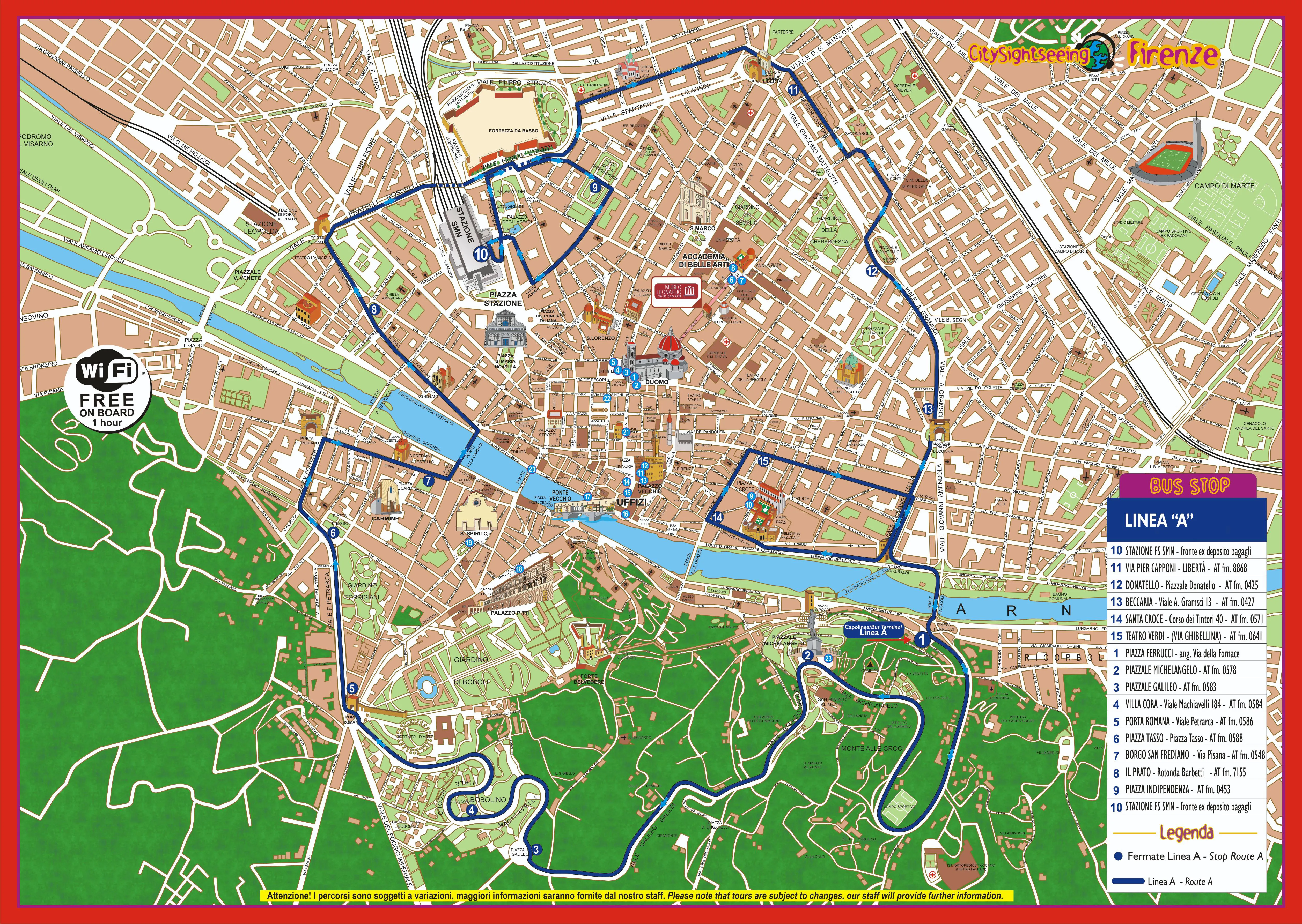
Navigating a new city can be daunting, but the Florence City Sightseeing map is your cheat sheet to the Renaissance. The map typically outlines two distinct routes: the urban Red Line (Line A) and the scenic Blue Line (Line B).
Here is a detailed breakdown of what you will find at the major stops along these routes, so you can plan your "hops" with precision.
🔴 Line A: The City Center Loop
This line circles the historic core. It’s perfect for seeing the main monuments and the flow of the Arno River.
Stop 1: Stazione (SMN Train Station)
- Location: Usually right outside the main exit of Santa Maria Novella station.
- What to See:
- Santa Maria Novella Basilica: A stunning Dominican church with a zebra-striped marble facade.
- Pharmacy of Santa Maria Novella: The oldest operating pharmacy in the world (est. 1221), selling ancient perfumes and elixirs.
Stop 6: Porta Romana (The South Gate)
- Location: A massive traffic circle with a giant stone gate and a modern art statue in the center.
- What to See:
- Boboli Gardens: This stop serves the "back entrance" to the gardens. It is often less crowded than the main Pitti Palace entrance.
- Porta Romana: One of the few remaining gates of the 14th-century walls.
Stop 10: Piazzale Michelangelo
- The Highlight: This is the reason many people take the bus. The bus climbs the winding Viale dei Colli to reach this 19th-century terrace.
- What to See:
- The View: The classic panoramic shot of Florence.
- San Miniato al Monte: A 5-minute walk up from the Piazzale, this Romanesque church is older and more mystical than the Duomo.
Stop 12/13: Santa Croce
- Location: Near the riverside.
- What to See:
- Basilica di Santa Croce: The "Temple of Italian Glories," housing the tombs of Michelangelo, Galileo, and Machiavelli.
- Leather School: The area is famous for leather workshops.
Stop 8/15: The "Viali" (Donatello / Beccaria)
- These stops are along the ring road.
- Donatello: Access to the English Cemetery, a romantic, island-like cemetery in the middle of the road where Elizabeth Barrett Browning is buried.
🔵 Line B: The Fiesole & Nature Route
This line shares some stops with Line A (like the Station and Piazzale Michelangelo) but then breaks away towards the North-East hills.
Stop: Fiesole (Main Square)
- The Destination: Fiesole is a separate town, perched high above Florence.
- What to See:
- Roman Theater: A well-preserved archaeological site with Roman baths and an Etruscan temple.
- Panoramic Terraces: The view from here is totally different from Piazzale Michelangelo—it’s higher, wider, and framed by olive groves.
- Monastery of San Francesco: A steep climb to a tiny, peaceful friary.
Stop: Stadio / Museo del Calcio
- For Sports Fans: This stop drops you near the Artemio Franchi stadium, home of AC Fiorentina.
- Museo del Calcio: The museum of the Italian National Team (Azzurri), located nearby in Coverciano.
Tips for Reading the Map
- Look for the "Intersect" Points: The map shows where Red and Blue lines overlap (usually Station and Piazzale Michelangelo). These are your transfer points.
- Direction Matters: The arrows on the map lines indicate the direction of travel. Most loops are one-way! If you miss a stop, you have to go all the way around.
- Frequency: Check the timetable box on the map. Line A usually runs every 20 mins, while Line B might be every 60 mins.
Accessibility on the Map
The map usually marks stops that are fully wheelchair accessible. While all buses have ramps, some specific stops might have rough pavement or lack a curb, making deployment difficult. The driver will always help you find the safest spot to disembark.
About the Author

Florence Explorer
We are passionate admirers of Florence dedicated to helping you see beyond the crowded main streets. Our guide helps you use the bus to unlock the panoramic beauty of the surrounding hills that many walking tourists miss.
Tags
Comments (0)
Loading comments...